design immersion presentation notes
Here is a rough draft of notes for my presentation. I certainly need to work on the succinctness of my story ( improving the "crispness" of my categories, as you say) . Any suggestions? What am I missing that's important?
We can break down the category of small refrigerators according to two attributes of a product: capacity and "type" (my word).
The three types are:
(a) refrigerator w/ separate freezer
(b) refrigerator w/ chiller compartment
(c) refrigerator only
As for capacity, I've considered capacities ranging from 1.7 - 12.0 cu.ft.
Note: when I refer to "small" fridges I mean fridges around the 1.7-12.0 capacity.
trends:
+ capacity tends to determine a unique size (e.g. 4.3 cu.ft. fridges all have outer dimensions of about 21" x 21" x 34")
+ you can get capacities in many increments of 0.1 cu.ft.
+ 1.7-6.0 are typically advertised as "compact refrigerators"
+ 6.0-12.0 are typically advertised as simply "refrigerators" or "apartment refrigerators"
+ 4.0 - 6.0 are often advertised for "under-counter" use. They are usually 33" high, which is the height of ADA countertops.
+ at 3.0 we start to see true separate freezers
+ at 3.5 we start to see crispers
+ at 6.0 and higher almost all have crispers
+ at 12.0 and higher almost all have separate freezers
+ the number of models with crispers and separate freezers increases with capacity
+ there is a gradual evolution in size and number of compartments; it goes from "compact refrigerators" meant for snacks and drinks to "full-size refrigerators" meant for meals
+ capacity and number of shelves and compartments is the single largest differentiator between small fridges and large fridges. Canstor, chillers and top-recessed door handles are the only features designed with the small fridge in mind.
Here is a visual summary (click to enlarge):

If I added more pictures of the many different in between capacities, you could start to see even more clearly the linear evolution from compact to full-size fridge. By this I mean that the number of compartments, new features and price tend to increase monotonically with capacity.
Players
There are a lot of players in the small fridge market. Summit offers the largest selection - they have models in every price range and almost every style. Avanti, Haier, Danby and Sanyo offer a wide range of small fridges. GE is one of the few brands that offers many small fridges as well as full-size fridges.
I haven't researched it much, but I haven't stumbled upon any interesting aftermarket small fridge products. I should probably look into food containers. I did come across several services that rent small refrigerators to college students.
Features
There doesn't appeart to be much innovating going on with small fridges, especially at the low-mid price range.
Almost every fridge has door bins/shelves and removable shelves in a main compartment . Almost all models have a door bin that can fit a 2-liter bottle of pop. Most have a recessed door handle and leveling legs. Many doors are reversible.
Most of the features found in small fridges such as various types of door bins, removable shelves and cripsers are all inherited from full size fridges. Moreover, there are many features present in large fridges that don't appear often or ever in small fridges. Also, the set of features of small fridges that seldom or never appear in large fridges is very small. Canstor, chiller compartments and top recessed door handles are the only features I'd put in this set. It's somewhat surprising that these are the only features I can find which seem to have been designed specifically for small fridges.

Technical Innovations
Some new performance features are Avanti's thermoelectric cooling and Summit's dual-evaporation system. Thermoelectric cooling reduces weight and maintenance (since its all solidstate electronics - no moving parts). However, it's not very efficient. I imagine that's why it's only used in a small number of models and only at the 1.7 and lower (such as small camping coolers). Summit's dual-evap apparently allows for an integrated true-freezer compartment within the main compartment ( a chiller that really freezes).
Design Innovations
The Soleus beverage cart and the Maytag skybox are like mini bars on wheels, intended for pool, patio and rec room environments. Summit, KitchenAid and some others make some expensive under-counter fridges that have drawers, icemakers and other features found in larger fridges. Danby recently came out with the GenII Canstor, which allows for easy access to individual cans.
hypotheses/observations
I've drawn the following hypothesis/observations, which are organized into groups below.
performance
people are confused, deceived or apathetic with respect to performance and reliability differences
+ students buy the cheapest fridge (for a given capacity and type)
+ brand name reliability isn't important; it only needs to last a couple years
+ buyers think chillers = freezers
+ energy efficiency isn't important to students; they don't pay utilities
market
there is a lack of innovation and specialty amongst small fridges
+ small fridges are for generic use
corollary: there are no small fridges specifically designed for or marketed towards college students
+ small and full-size fridges differ mainly in size and number of compartments
+ few features are designed specifically for small fridges (Canstor, chiller and top recessed door handles are the exceptions)
+ the biggest purchase drivers are capacity (associated with size and portability), type, price and availability
internal organization
small fridge users need/want more efficient, flexible and convenient organizational systems
+ fridge contents change with time; consequently, so do optimal interior configurations
+ reorganizing contents is a frequent chore
+ people don't reconfigure adjustable shelves (you have to remove all the items first)
+ crispers are used for long-lifetime, infrequent-use items, rather than the short-lifetime items they were intended for
+ single serving and other small items are common to fridges
+ people have lots of wasted vertical space in their fridge
+ food is buried and forgotten about in deep spaces
+ canstor is good for pop, but not for much else
+ people underestimate the fridge size they need/want
+ people try to put more in their fridge than it can comfortably hold
+ people plan meals and shopping lists according to what will fit in their fridge
college eating
+ students would cook more if they had more kitchen resources
+ fridges don't help with meal planning and preparation
+ college students eat and prepare a lot of unhealthy meals
aesthetic, social, reflective experience
+ fridges are utilitarian; they are not cool; they are not personal
+ fridges offer a poor aesthetic experience
+ food is an integral part of people's live: it is necessary, pleasurable and enjoyable; it brings people together
+ students learn to plan and prepare food for themselves when away at college
opportunities
My hypotheses/observations about the market suggest that the industry could profit by offering a product that says "I'm designed specifically for college students". As for designing such a fridge, I have the following ideas.
A compact fridge for college students should be:
+ small
+ inexpensive
Size is an issue not only because of room space constraints, but also because of the difficulty with transporting large items. The price should be relatively inexepensive because most college students plan on the fridge being a short term investment.
I'm seeing internal organization as a major opportunity for improvement. The compact fridge should be about organizing a lot of various food items in a little space. Removing and inserting items, as well as cleaning and reconfiguring the means of organization, should be:
+ flexible
+ space efficient
+ quick and easy
The fact that there aren't any organization features designed specifically for small fridge users might mean that no one has really tried to innovate in this area.
The last two groups of hypothesis/observations is stuff that seemed to transcend the current ideas about small fridges (as represented by the current market). These last two categories suggest going beyond an isolated product, towards an integrated experience.
The "college eating" hypothesis suggest a mulitifunctional, mini-kitchen. By this, I mean products that help students to plan and prepare meals in the context of college life. An example might be containers for organizing items inside the fridge which can be used outside of the fridge to aid in meal preparation. So, maybe the the new product should be a modular, portable container system rather than just a new shelf layout. Another related idea might be extendible space for meal preparation. Modular containers could help with this, as could collapsable countertop extensions. Yet another idea is to better integrate other food preparation tools and appliances into the mini fridge. For example, integrating a stovetop into the fridge body in some way.
These ideas about a mini-kitchen start to suggest a product that is truly integrated into the life flow of the user. The second category "aesthetic, social and reflective experience" is about ideas that go even farther beyond functionality. I'm still pretty hazy about what this could mean. Ideally, a mini-kitchen should support social interaction, such as sharing recipes or tips on organization as well as sharing meals and conversation. It should also support the user in actively designing their own personal mini-kitchen (if they so desire). Also, since food is such an integral part of our lives, it seems that it is especially appropriate/possible that the overall aesthetic experience of the small refrigerator be improved.
future research
Things I want to learn about people:
+ contents - what foods do they buy? what do they keep in the fridge? how do contents change with time?
+ tools - what resources do they use during the "food process" ( planning, shopping, organizing, preparing, eating, cleaning)?
+ eating and preparing - how often do they prepare meals? in what contexts?
+ social and personal relationships with food processes - what does this mean to people? what do they desire?
+ good and poor designs - what do users like and not like? what do they want?
In particular, I want to observe and talk to users who have a large quantity and diversity of food items in their fridge, and prepare lots of meals.
Things I want to learn about technical performance:
+ what are effects of packing a fridge to the max?
+ what are important issues with energy efficiency and performance of fridges?
Things I want to learn about the market and related products:
+ what innovations are happening with full-size fridges, with full-size and small-living space kitchens?
+ what are some other products that offer great organizing systems to copy from?
We can break down the category of small refrigerators according to two attributes of a product: capacity and "type" (my word).
The three types are:
(a) refrigerator w/ separate freezer
(b) refrigerator w/ chiller compartment
(c) refrigerator only
As for capacity, I've considered capacities ranging from 1.7 - 12.0 cu.ft.
Note: when I refer to "small" fridges I mean fridges around the 1.7-12.0 capacity.
trends:
+ capacity tends to determine a unique size (e.g. 4.3 cu.ft. fridges all have outer dimensions of about 21" x 21" x 34")
+ you can get capacities in many increments of 0.1 cu.ft.
+ 1.7-6.0 are typically advertised as "compact refrigerators"
+ 6.0-12.0 are typically advertised as simply "refrigerators" or "apartment refrigerators"
+ 4.0 - 6.0 are often advertised for "under-counter" use. They are usually 33" high, which is the height of ADA countertops.
+ at 3.0 we start to see true separate freezers
+ at 3.5 we start to see crispers
+ at 6.0 and higher almost all have crispers
+ at 12.0 and higher almost all have separate freezers
+ the number of models with crispers and separate freezers increases with capacity
+ there is a gradual evolution in size and number of compartments; it goes from "compact refrigerators" meant for snacks and drinks to "full-size refrigerators" meant for meals
+ capacity and number of shelves and compartments is the single largest differentiator between small fridges and large fridges. Canstor, chillers and top-recessed door handles are the only features designed with the small fridge in mind.
Here is a visual summary (click to enlarge):
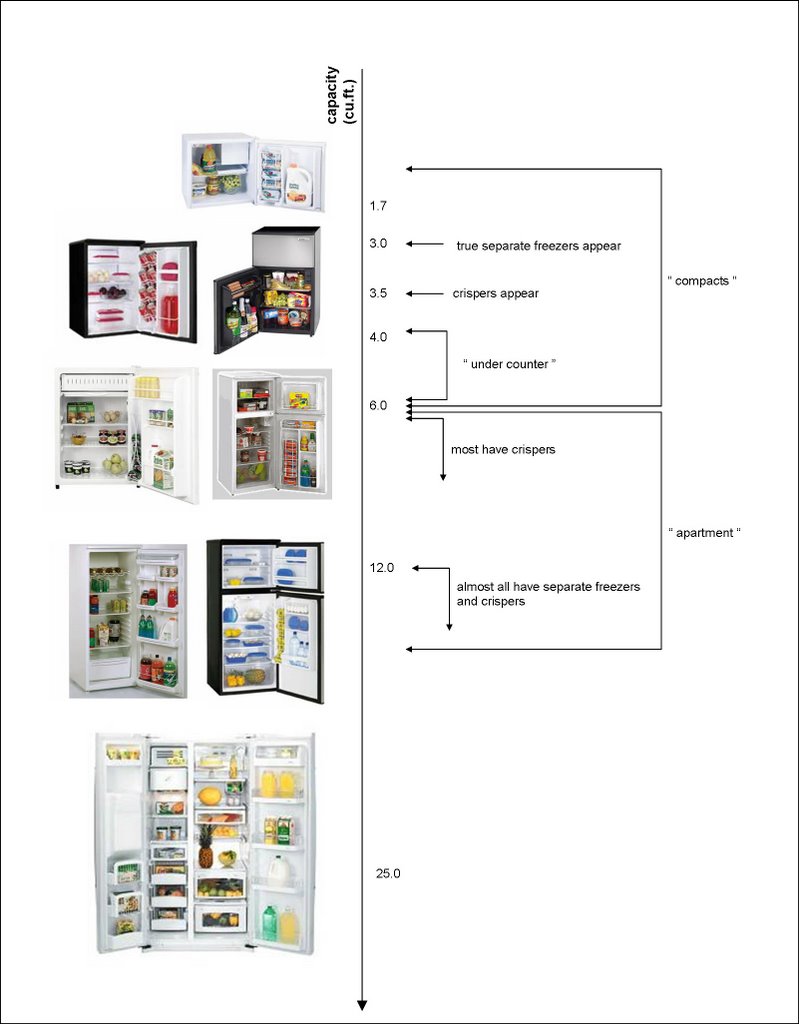
If I added more pictures of the many different in between capacities, you could start to see even more clearly the linear evolution from compact to full-size fridge. By this I mean that the number of compartments, new features and price tend to increase monotonically with capacity.
Players
There are a lot of players in the small fridge market. Summit offers the largest selection - they have models in every price range and almost every style. Avanti, Haier, Danby and Sanyo offer a wide range of small fridges. GE is one of the few brands that offers many small fridges as well as full-size fridges.
I haven't researched it much, but I haven't stumbled upon any interesting aftermarket small fridge products. I should probably look into food containers. I did come across several services that rent small refrigerators to college students.
Features
There doesn't appeart to be much innovating going on with small fridges, especially at the low-mid price range.
Almost every fridge has door bins/shelves and removable shelves in a main compartment . Almost all models have a door bin that can fit a 2-liter bottle of pop. Most have a recessed door handle and leveling legs. Many doors are reversible.
Most of the features found in small fridges such as various types of door bins, removable shelves and cripsers are all inherited from full size fridges. Moreover, there are many features present in large fridges that don't appear often or ever in small fridges. Also, the set of features of small fridges that seldom or never appear in large fridges is very small. Canstor, chiller compartments and top recessed door handles are the only features I'd put in this set. It's somewhat surprising that these are the only features I can find which seem to have been designed specifically for small fridges.

Technical Innovations
Some new performance features are Avanti's thermoelectric cooling and Summit's dual-evaporation system. Thermoelectric cooling reduces weight and maintenance (since its all solidstate electronics - no moving parts). However, it's not very efficient. I imagine that's why it's only used in a small number of models and only at the 1.7 and lower (such as small camping coolers). Summit's dual-evap apparently allows for an integrated true-freezer compartment within the main compartment ( a chiller that really freezes).
Design Innovations
The Soleus beverage cart and the Maytag skybox are like mini bars on wheels, intended for pool, patio and rec room environments. Summit, KitchenAid and some others make some expensive under-counter fridges that have drawers, icemakers and other features found in larger fridges. Danby recently came out with the GenII Canstor, which allows for easy access to individual cans.
hypotheses/observations
I've drawn the following hypothesis/observations, which are organized into groups below.
performance
people are confused, deceived or apathetic with respect to performance and reliability differences
+ students buy the cheapest fridge (for a given capacity and type)
+ brand name reliability isn't important; it only needs to last a couple years
+ buyers think chillers = freezers
+ energy efficiency isn't important to students; they don't pay utilities
market
there is a lack of innovation and specialty amongst small fridges
+ small fridges are for generic use
corollary: there are no small fridges specifically designed for or marketed towards college students
+ small and full-size fridges differ mainly in size and number of compartments
+ few features are designed specifically for small fridges (Canstor, chiller and top recessed door handles are the exceptions)
+ the biggest purchase drivers are capacity (associated with size and portability), type, price and availability
internal organization
small fridge users need/want more efficient, flexible and convenient organizational systems
+ fridge contents change with time; consequently, so do optimal interior configurations
+ reorganizing contents is a frequent chore
+ people don't reconfigure adjustable shelves (you have to remove all the items first)
+ crispers are used for long-lifetime, infrequent-use items, rather than the short-lifetime items they were intended for
+ single serving and other small items are common to fridges
+ people have lots of wasted vertical space in their fridge
+ food is buried and forgotten about in deep spaces
+ canstor is good for pop, but not for much else
+ people underestimate the fridge size they need/want
+ people try to put more in their fridge than it can comfortably hold
+ people plan meals and shopping lists according to what will fit in their fridge
college eating
+ students would cook more if they had more kitchen resources
+ fridges don't help with meal planning and preparation
+ college students eat and prepare a lot of unhealthy meals
aesthetic, social, reflective experience
+ fridges are utilitarian; they are not cool; they are not personal
+ fridges offer a poor aesthetic experience
+ food is an integral part of people's live: it is necessary, pleasurable and enjoyable; it brings people together
+ students learn to plan and prepare food for themselves when away at college
opportunities
My hypotheses/observations about the market suggest that the industry could profit by offering a product that says "I'm designed specifically for college students". As for designing such a fridge, I have the following ideas.
A compact fridge for college students should be:
+ small
+ inexpensive
Size is an issue not only because of room space constraints, but also because of the difficulty with transporting large items. The price should be relatively inexepensive because most college students plan on the fridge being a short term investment.
I'm seeing internal organization as a major opportunity for improvement. The compact fridge should be about organizing a lot of various food items in a little space. Removing and inserting items, as well as cleaning and reconfiguring the means of organization, should be:
+ flexible
+ space efficient
+ quick and easy
The fact that there aren't any organization features designed specifically for small fridge users might mean that no one has really tried to innovate in this area.
The last two groups of hypothesis/observations is stuff that seemed to transcend the current ideas about small fridges (as represented by the current market). These last two categories suggest going beyond an isolated product, towards an integrated experience.
The "college eating" hypothesis suggest a mulitifunctional, mini-kitchen. By this, I mean products that help students to plan and prepare meals in the context of college life. An example might be containers for organizing items inside the fridge which can be used outside of the fridge to aid in meal preparation. So, maybe the the new product should be a modular, portable container system rather than just a new shelf layout. Another related idea might be extendible space for meal preparation. Modular containers could help with this, as could collapsable countertop extensions. Yet another idea is to better integrate other food preparation tools and appliances into the mini fridge. For example, integrating a stovetop into the fridge body in some way.
These ideas about a mini-kitchen start to suggest a product that is truly integrated into the life flow of the user. The second category "aesthetic, social and reflective experience" is about ideas that go even farther beyond functionality. I'm still pretty hazy about what this could mean. Ideally, a mini-kitchen should support social interaction, such as sharing recipes or tips on organization as well as sharing meals and conversation. It should also support the user in actively designing their own personal mini-kitchen (if they so desire). Also, since food is such an integral part of our lives, it seems that it is especially appropriate/possible that the overall aesthetic experience of the small refrigerator be improved.
future research
Things I want to learn about people:
+ contents - what foods do they buy? what do they keep in the fridge? how do contents change with time?
+ tools - what resources do they use during the "food process" ( planning, shopping, organizing, preparing, eating, cleaning)?
+ eating and preparing - how often do they prepare meals? in what contexts?
+ social and personal relationships with food processes - what does this mean to people? what do they desire?
+ good and poor designs - what do users like and not like? what do they want?
In particular, I want to observe and talk to users who have a large quantity and diversity of food items in their fridge, and prepare lots of meals.
Things I want to learn about technical performance:
+ what are effects of packing a fridge to the max?
+ what are important issues with energy efficiency and performance of fridges?
Things I want to learn about the market and related products:
+ what innovations are happening with full-size fridges, with full-size and small-living space kitchens?
+ what are some other products that offer great organizing systems to copy from?
posted by jamesjpierce at 9:58 PM


1 Comments:
great work. you are really cracking this and getting ready for user research. it's a great moment when you bursting at the seams with wanting to start research and have very specific things you are looking for.
i agree with jon, try and edit yourself down to get your story even more concise. i think the ways you have organized it are great. try and find a good thread to tell a story. look for an interesting narrative device that is beyond your analysis, something that you know everyone can identify with.
some specific notes:
+ as you start to break down types of fridges (per Jon's notes) you can jettison the cubic size measurement. it's too technical and confusing. but good background knowledge.
+ cool visual summary. do more of that for your other areas of analysis (players, features, innovations). make it visually rich with products and call outs!
+ players: can you characterize the competition? what makes their products unique and different?
+ features: "It's somewhat surprising that these are the only features I can find which seem to have been designed specifically for small fridges." WHY?!
+ great summary of your next steps. you are really digging deep and challenging yourself on what you don't know. keep this as a to-do list. it would help to start to organize these. for instance, for what you want to learn from users, how can you organize those questions better?
keep up the great work, James.
Post a Comment
<< Home